Half the gutter calls we run across Eastern Kentucky, Western West Virginia, and Southern Ohio start the same way: 'My gutters overflow every time it rains.' But the fix isn't always the same. Sometimes the troughs are too small, sometimes they're clogged with oak tassels and pine needles, and sometimes the whole system is back-pitched and dumping water at the foundation. Seamless gutters and leaf guards solve two different problems — and a lot of homes need both. Here's how we sort it out, and what actually stops foundation water before it reaches your basement.
What Seamless Gutters Actually Do Better
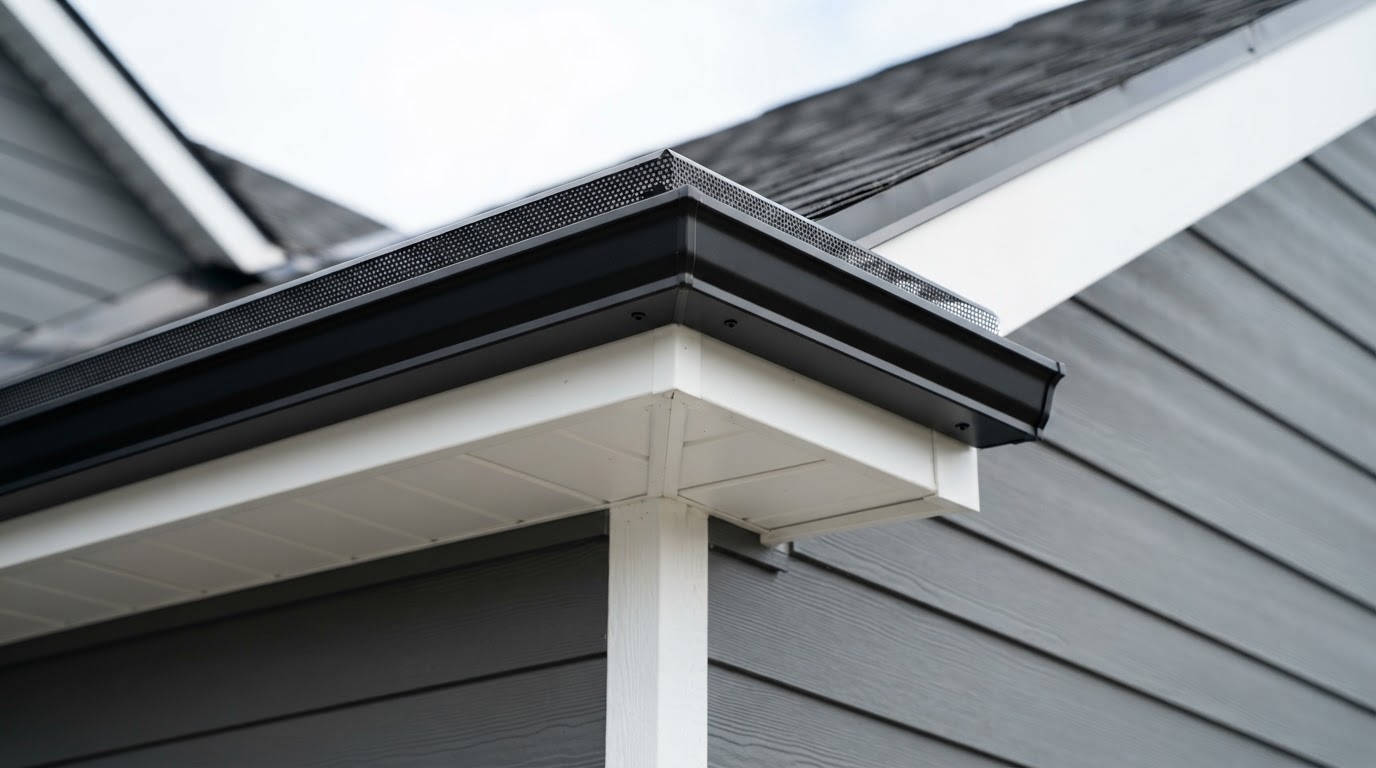
Seamless gutters are roll-formed right on your driveway to the exact length of your roofline, so there are no joints to leak. The seams on old sectional gutters are where they fail — they leak, rot the fascia behind them, and pull loose. Seamless 5-inch or 6-inch aluminum troughs carry more water, don't leak at the corners, and last decades. For most tri-state homes with steep roofs and heavy downpours, we recommend 6-inch seamless because it carries about 50% more water than 5-inch — the right call when the roof area is large or the basement is below grade.
When the Real Problem Is Clogs, Not the Gutters
If your gutters overflow in a normal rain but drain fine after the leaves fall, the troughs aren't broken — they're full. The hills and hollows around Paintsville, Hurricane, and Wayne WV drop heavy leaf loads twice a year, and that debris mats down and blocks the downspout openings. Cleaning twice a year keeps it moving, but most homeowners would rather never climb a ladder again. That's where leaf guards earn their cost.
Why Micro-Mesh Leaf Guards Beat Foam and Reverse-Curve
There are three kinds of leaf guards, and two of them don't work for long. Foam inserts clog with grit and grow moss. Reverse-curve covers let small debris in and clog the opening. Surgical stainless-steel micro-mesh is what we install — it blocks pine tassels, oak grit, and roof shingle granules while still passing heavy downpours. Most tri-state homeowners we fit with micro-mesh never clean their gutters again. It's the only guard that handles the Appalachian leaf drop.
Signs Your Foundation Water Is a Gutter Problem
Before you call a foundation company, check the gutters. Water pooling at the foundation, damp crawl spaces, washed-out flowerbeds, and peeling paint on the fascia board are all gutter symptoms. If roof runoff dumps right at the base of your wall — which it does when downspouts are too short or troughs are back-pitched — the water table around your footing rises every storm. Fix the gutters first. We re-pitch, replace rotted fascia, and extend downspouts 10+ feet out so the water never sits against the wall.
Downspouts and Drainage: The Half Most People Forget
Even perfect gutters fail if the downspouts dump water right at the corner. Roof area collects hundreds of gallons in a single storm, and all of it has to go somewhere safe. We extend downspouts and, where the lot allows, run underground drainage to daylight at least 10 feet from the foundation. On sloped lots in the hills, that's the difference between a dry basement and a wet one. It's the unglamorous half of a gutter system, and it's where we see most of the water-intrusion damage we're called to fix.
How to Know Which Your Home Needs
If your troughs are leaking at the seams, pulling off the fascia, or undersized for the roof — replace with seamless. If they're in good shape but clog constantly — add micro-mesh guards. If water sits at the foundation — extend the downspouts and grade the soil. Most of the time it's a combination, and the free estimate sorts it out. We measure your roofline, look at the pitch and the downspout routing, and tell you the smart order of operations — not just the most expensive one. Call (740) 744-1682 anywhere in KY, WV, or OH.
Got a question about your roof, gutters, or deck?
Skip the research and talk to the crew that runs the ladders. We'll inspect your property and give you a straight answer — free. Call (740) 744-1682 or request an estimate below.